Crispin Colvin: Protecting Farmland, Shaping Policy

Crispin Colvin chose farming as a way of life more than 50 years ago, when his family bought farmland in Thames Centre in 1971. Since then, apart from a brief time spent in Scotland, he has remained on the land, committed to growing food, building community, and strengthening connections between rural and urban Ontario. As a farmer, policy advocate, and bridge-builder, Crispin brings a rare blend of hands-on experience and big-picture perspective to his work.

Crispin and his family operated a mixed farm, raising highland cattle and growing corn, soybeans, and wheat. His deep roots in agriculture have shaped a decades-long commitment to protecting farmland, strengthening land use planning, and advocating for Ontario’s farming communities. As a former Director with the Ontario Federation of Agriculture, representing Lambton and Middlesex counties, Crispin played a key role in bringing the voice of local producers to provincial discussions. He currently serves as a board member with the Middlesex Federation of Agriculture (MFA) and recently joined the Middlesex London Food Policy Council as MFA’s representative.
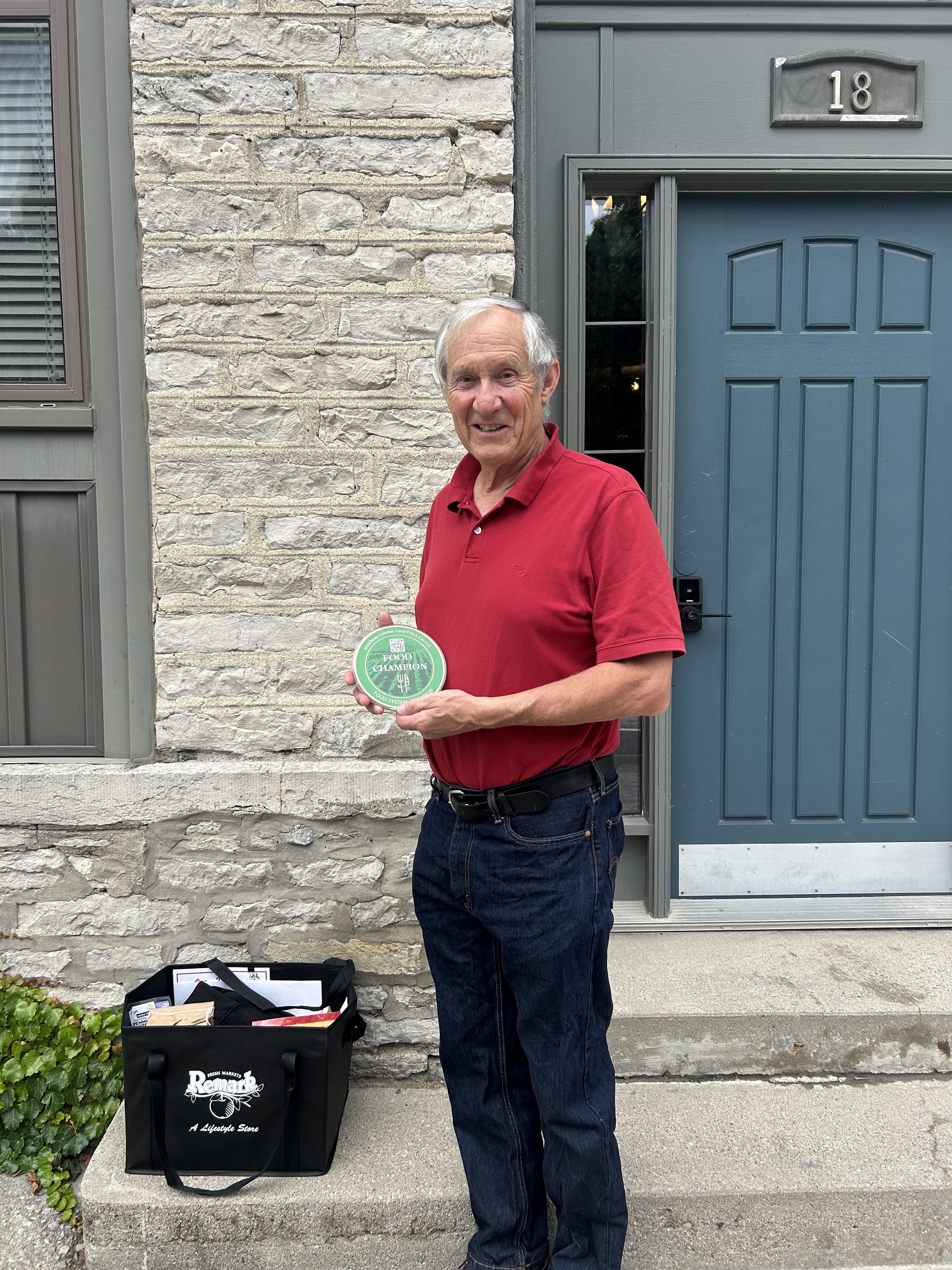
Crispin Colvin stands outside a stone building beside a blue door marked “18,” holding the 2025 Food System Champion green circular plaque, with a black tote bag at his feet.
Crispin Colvin, winner of the raffle draw and holding a 2025 Food Systems Champion plaque.

Crispin’s impact stretches far beyond the fields. He has served as Chair of Farm & Food Care Ontario, Mayor of Thames Centre, Warden of Middlesex County, and Chair of the Board of Governors at Fanshawe College. He’s also contributed his time and expertise to boards at Western University, the London Training Centre, and the London Convention Centre, always helping connect food production to education, economic development, and public understanding.

At every turn, Crispin has been a steady advocate for farmland preservation. It’s a mission he sees as both urgent and essential.

“Agricultural land is being lost at an unprecedented rate,” he says. “Once land is taken out of production, it will never come back. It is lost forever. It is imperative that we preserve this non-renewable resource so that we may feed Ontario, Canada, and the world.”

Crispin is particularly known for his personal approach: generous with his time, collaborative in conversation, and always ready to share insight with farmers, policymakers, and community members alike. Whether at the Thorndale Fair or a city council meeting, he’s there showing up, listening, and speaking up for the land and the people who care for it.

Through leadership and a lifelong connection to the land, Crispin Colvin continues to help shape a stronger, more resilient food system for everyone.
No Reconciliation Without Truth: MLFPC’s Responsibility to Indigenous Truth in Food Systems

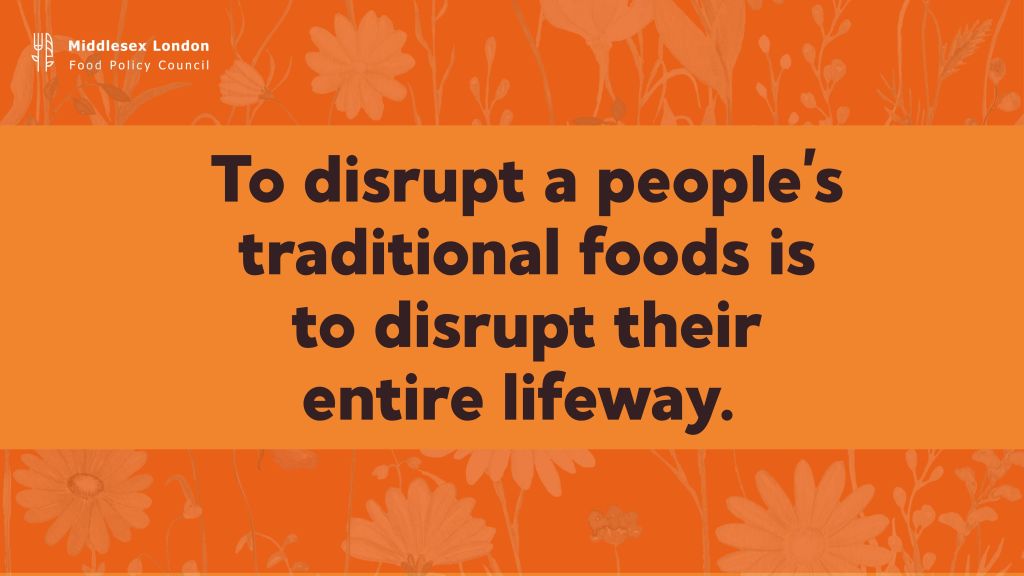
An orange background with a floral pattern and the text 'To disrupt a people's traditional foods is to disrupt their entire lifeway.' In the top left corner, the logo and name 'Middlesex London Food Policy Council' are displayed.

Written by: Siobhan Watters

September 30th is Canada’s National Day for Truth and Reconciliation. The Middlesex-London Food Policy Council (MLFPC) is taking this month to educate ourselves and honour our relations with the Indigenous peoples of Canada. Throughout September, we will communicate and celebrate the efforts of local Indigenous organizations that promote Indigenous sovereignty and healing through food-based initiatives. However, as many Indigenous leaders have said, there is no Reconciliation without Truth. Today, we acknowledge the hard truths of Canada’s colonization of Indigenous peoples, a story that must include food.

The Truth and Reconciliation Commission (TRC) was established in 2007 to facilitate reconciliation with survivors and families affected by the Canadian residential school system. The TRC concluded that the forcible removal of more than 150,000 Indigenous children to residential schools, the last of which closed its doors in 1997, was an act of “cultural genocide.” We also know now that, in addition to numerous abuses suffered at these schools, Indigenous children were subjected to  nutritional experiments without their consent. These experiments would eventually inform the development of Canada’s Food Guide.

The importance of Indigenous food sovereignty

An important outcome of the TRC’s work was its 2015 final report including 94 Calls to Action, a document that continues to inform reconciliation efforts between Canadians and Indigenous people today. Notably, Calls to Action 13-17 support revitalization of Indigenous culture, but surprisingly, the word “food” is not mentioned at all in the document—although it may be implied in the Calls to Action concerning health. However, non-Indigenous peoples may not appreciate the holistic ways that Indigenous peoples view their relationship to food, around which many ceremonies and social gatherings revolve. Food is medicine and key to intergenerational healing and cultural revitalization. 

If we are to truly embrace Reconciliation, we must acknowledge the uncomfortable Truth that present-day, industrially-driven food systems operate in contradiction to the land-based wisdom of Indigenous peoples and play a role in the continuing settler-colonization of Indigenous lands and destruction of Indigenous lifeways. To eliminate or transform a people’s traditional foods is to disrupt their entire lifeway. Access to traditional Indigenous foods is now severely limited, and where it is available, can be very expensive. We look forward to sharing more about the important work being done locally to address Indigenous food sovereignty and healing, by organizations such as the Southwest Ontario Aboriginal Health Access Centre, Wampum Learning Lodge, and Oneida Original Foods.

An orange background with a floral pattern. The text reads 'To disrupt a people's traditional foods is to disrupt their entire lifeway.' The logo and name 'Middlesex London Food Policy Council' appear in the top left corner.

MLFPC’s commitment to Truth and Reconciliation

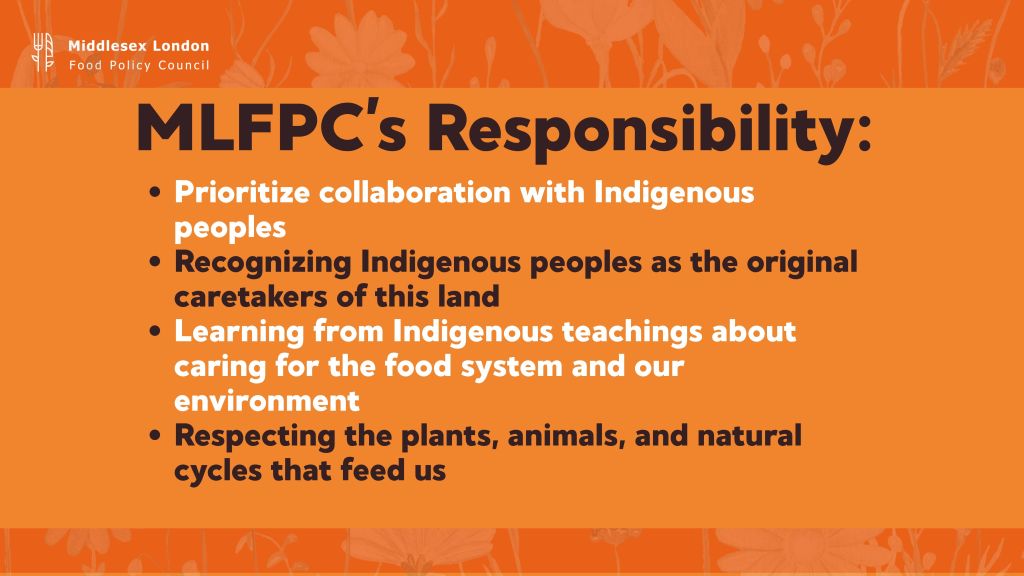
With a mission to represent the full range of people participating in the local food system, the MLFPC has a responsibility to recognize Indigenous rights holders as the original stewards of this land. To achieve our goals of developing a “healthier, sustainable, resilient and equitable food system,” we must also open ourselves to the wisdom of Indigenous teachings about the environment, forming right relations with the animals and plants that feed us, and appreciating the cycles of nature upon which our food systems are built. Members of the council have begun this work by learning appropriate steps towards relationship building with Indigenous communities, with thanks to Atlohsa Family Healing Services for their education program and the London Environmental Network for connecting Indigenous Knowledge Holders with local organizations such as ours.

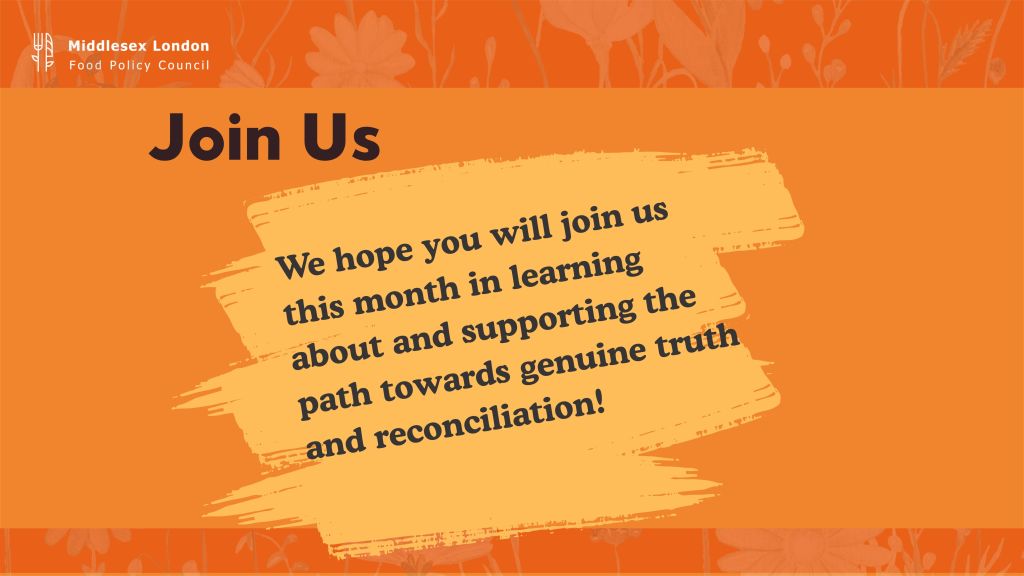
We hope you will join us this month in learning about and supporting the path towards genuine truth and reconciliation! 

An orange background with floral patterns. The top left corner features the logo of Middlesex London Food Policy Council. The text reads 'MLFPC's Responsibility:' followed by four bullet points: 1) Prioritize collaboration with Indigenous peoples, 2) Recognizing Indigenous peoples as the original caretakers of this land, 3) Learning from Indigenous teachings about caring for the food system and our environment, 4) Respecting the plants, animals, and natural cycles that feed us.

You should know!

Middlesex-London sits on the traditional territories of the Anishinaabek, Haudenosaunee, Lūnaapéewak, and Attawandaron. We are neighbours to Chippewas of the Thames First Nation, Oneida Nation of the Thames, and the Munsee-Delaware Nation. As of 2022, nearly 11,000 people living in the region identified as Indigenous, and the population is growing at a rate consistent with Middlesex-London’s overall population boom. 

In addition to the links provided above, here are more resources for you to explore:

Visit the Indigenous Food Sovereignty Network’s website

An orange banner with floral patterns in the background. The top left corner displays the logo and name 'Middlesex London Food Policy Council.' Large bold text reads 'Join Us.' Below, in a yellow paintbrush stroke design, the message says: 'We hope you will join us this month in learning about and supporting the path towards genuine truth and reconciliation!'