
By: Alyssa Rush,
Communications Volunteer with the Middlesex London Food Policy Council, Alyssa is a PhD student at Queen’s University living in London, Ontario. Her research focuses on agroecology, sustainable agriculture, and local food systems, with a passion for equity, social justice, and community.
This month at the Middlesex London Public Health Unit (MLFPC), we are highlighting the importance of supporting community food security for equity-denied groups. To showcase the transformative work that Type Diabeat-it is doing in London, we sat down with Mystery Furtado, the founder and driving force behind this remarkable non-profit organization.
Type Diabeat-it supports low-income, racialized and marginalized communities who live with diabetes. In addition to distributing food boxes throughout the city to those who need them, Type Diabeat-it also runs food literacy programs, as well as the first black-led community garden in London.
![The image features a quote about addressing type 2 diabetes through cultural competency and food security, accompanied by a photo of Mystery Furtado. The text reads:
"On a high level, we're addressing type two diabetes. But we do this, I think, very creatively by addressing food insecurity, talking about food deserts, access to cultural food, and looking at it through a cultural lens ... [we are] really focusing on cultural competency, not only in diabetes management from a clinical perspective but from a community and preventative perspective."*
— Mystery Furtado
The background is a gradient of orange and yellow, and the logo "TypeDiabeatit" is displayed at the top, with "Dia" in red and the rest in blue. Mystery Furtado is pictured on the right, wearing vibrant clothing with bold patterns and unique earrings.](https://mlfpc.ca/wp-content/uploads/2025/02/1-1024x512.jpg)
Type Diabeat-it provides food boxes to around 400 families every month within the London area. Driven by a commitment to equity and the knowledge that there needs to be more supports and resources for the BPOC community in London, Mystery knows what it feels like to struggle.

This commitment to equity serves as a driving force for Type Diabeat-it. Food boxes distributed by the charity focus heavily on fresh produce. Recognizing that families are facing a lack of fresh produce, these food boxes focus on healthy greens, including Afro greens such as callaloo, okra, swiss chard, and mustard greens. In addition to serving as important sources of nutrients, these vegetables also are directly linked to reducing blood sugars. This commitment to providing fresh fruits and vegetables allows Type Diabeat-it to provide healthy food for families across London, that may not have access to these types of foods due to systemic barriers.
The community garden, Harvest Haven, now boasts a bigger greenhouse, solar power, and an in-ground well. Situated on land donated by Cardinal Fine Cabinetry, Harvest Haven is now positioned to grow food to help the community.
![The image features a quote from Mystery Furtado about Harvest Haven, emphasizing its purpose as a place of pride, community, and growth. The text reads:
"So, Harvest Haven is literally in the name. It’s going to be where you can harvest as much food and also have a sense of pride. So, the reason why [we named it]... Haven is peace... we’re so excited for this planting season. We’ve been able to invite classrooms onto the land, which has been so beautiful... Now we have electricity. The greenhouse is warm, our solar panel is up, and we have water that we can pump so the plants can grow."
— Mystery Furtado
The background is a gradient of green shades with quotation marks at the top left. At the bottom left, the "TypeDiabeatit" logo is displayed, with "Dia" in red and the rest in blue.
On the right side of the image, there is a photo of vibrant green seedlings growing in dark soil. A hand is gently tending to one of the plants, highlighting the care and attention involved in nurturing growth. The plants have visible water droplets on their leaves, giving a fresh and thriving appearance.](https://mlfpc.ca/wp-content/uploads/2025/02/3-1024x512.jpg)
With the garden, Mystery hopes to teach people to have a connection to the land and learn where food comes from. With a strong emphasis on growing cultural and ethnic foods, Type Diabeat-it aims to remove the stigma surrounding certain foods and recognizing them instead as healthy and valuable. Historically, food has travelled all over the world and serves as a universal language to connect people to each other and the land. Beyond looking at health from purely a clinical perspective, Mystery emphasizes the importance of building community through working with the land as well.
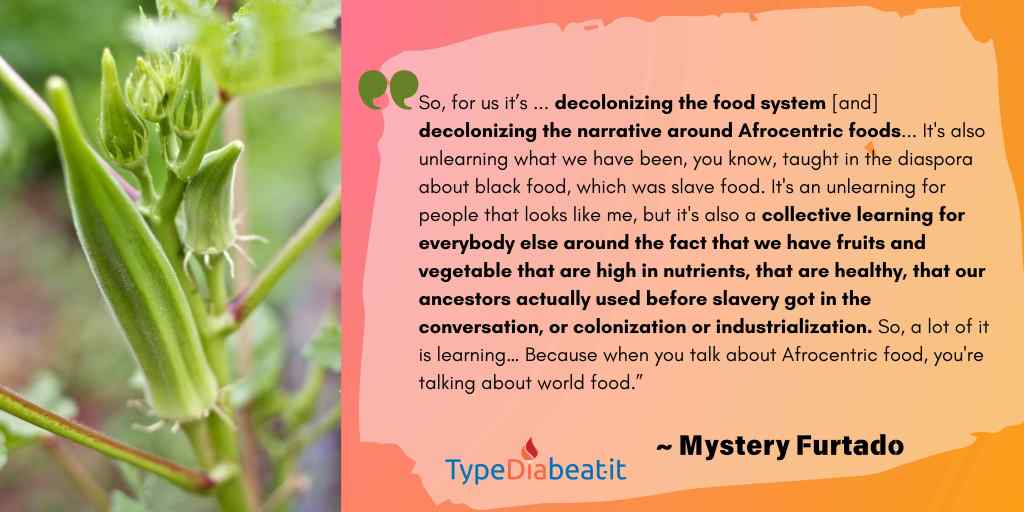
Acknowledging that we live in a food system that has prioritized certain types of food over others, Mystery emphasizes that the issue is not whether certain foods are “better” or “worse,” but if these foods are grown in ways that are sustainable. She hopes to serve as an inspiration for others with the important work she is doing with Type Diabeat-it.
Another important initiative that this organization is doing is the ten-week Afro-heritage literacy program across some schools within the Thames Valley District School Board. Approaching the Canadian food guide from an ethnic lens, the program discusses grains such as quinoa, couscous, millet, and sorghum. Incorporating a sensory curriculum, students are able to touch the food, ask questions, and taste it. The program runs from grades four up until high school. It creates a safe space for kids, where they are able to eat healthy, plant-based meals and are free to say if they don’t like something.
For those wanting to get involved with Type Diabeat-it, a primarily volunteer-led organization, there are many opportunities available. Extra hands to pick up food or sort the food boxes are always welcome. If you have the means to donate, Type Diabeat-it is a charity that would greatly appreciate any financial contributions to fund these important initiatives.
In November, Type Diabeat-It will host their annual health fair in downtown London, at the Covent Garden Market. In order to decentralize health services and access to support services, this event aims to create a relaxed environment in which community members can learn more about programs and services offered by various health programs and medical services in London.
Despite all of these amazing initiatives, Mystery acknowledges that there is still much work to be done. Emphasizing the importance of having conversations around food access for equity-denied groups, we recognize there is still a lot of important work that needs to be done. Fortunately, groups like Type Diabeat-it can serve as an inspiration for others to get involved in the London area in these important initiatives.