
Written by Joud Ibraheem. Edited by Ginette Blake.
Food insecurity, defined as inadequate or insecure access to food due to a lack of money, remains a prominent community issue despite broader economic growth (Middlesex-London Health Unit, 2025). For example, in 2023, one in four households in London-Middlesex experienced food insecurity, even though the local agri-food industry contributed $1.2 billion to the economy the previous year (Summers & Williams, 2024; Palmer, 2024).
In response, food security and nutrition educators have developed an alternative framework: community food security, first proposed by Sattanno et al. (2007) and discussed more recently in Middlesex London’s 2022 Community Food Assessment. This concept emphasizes interconnected pillars of a sustainable and equitable food system. By addressing each aspect, communities can develop more comprehensive strategies to reduce food insecurity. Below, each pillar of community food security is explored, first through a visual infographic, followed by a detailed written description that expands on its significance and impact.
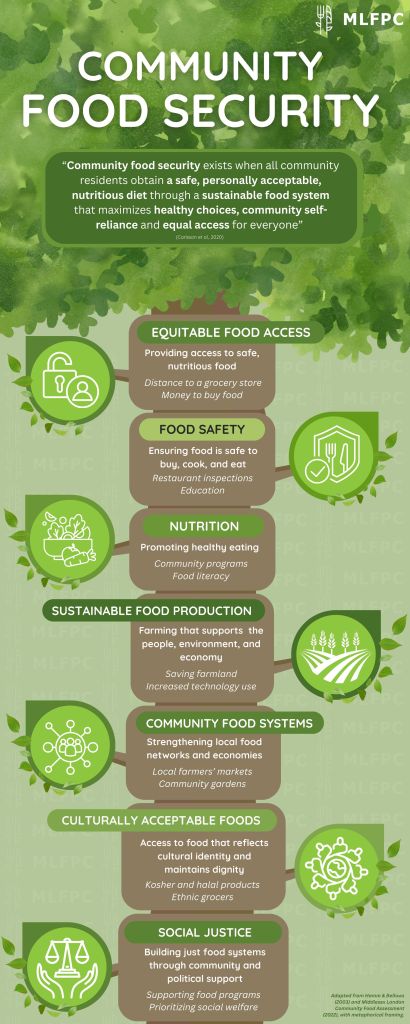
Equitable Food Access
Food access refers to the availability of safe, nutritious and adequate foods, often challenged by food deserts and poor living wages (Middlesex London Community Food Assessment, 2022). In Middlesex-London, factors such as distance to grocery stores, access to public transit, and income levels all influence a person’s ability to access food.
Food Safety
Food safety involves both the quality of the food and the knowledge needed to prepare and handle it safely (Sattanno et al., 2007). Locally, the Middlesex-London Health Unit (MLHU) plays a critical role through food safety inspections, food handler training programs and the distribution of educational materials for food service providers and consumers.
Nutrition
Community nutrition goes beyond individual dietary choices and addresses the social, cultural and environmental factors that influence how people eat. Nutrition-related policies and programs that offer public support are essential in building food literacy, and healthier, more resilient communities (Carlsson et al., 2020).
Sustainable Food Production
Sustainable agriculture aims to save farmland, increase opportunities for urban agriculture all year round, and raise immigration and the use of technology to assist with labour demands (Middlesex London Community Food Assessment, 2022). While farmers lead the way, community organizations like the Middlesex-London Food Policy Council and London Environmental Network help amplify their efforts (Braden, 2020).
Community Food Systems
Community food systems support strong, self-reliant local food economies, and encourage cooperative community partnerships. For instance, farmers’ markets across the region help circulate money within the community and create connections between producers and consumers (Visit Middlesex County, n.d.).
Culturally Acceptable Foods
Food plays a functional, emotional, and social role in our lives, thus requiring a holistic approach that maintains dignity (Middlesex London Community Food Assessment, 2022). For example, cultural acceptability refers to both the types of food available and the ways in which they are procured (Sattanno et al., 2007). A major indicator of food insecurity is eating culturally-inadequate foods. To address this, the presence of ethnic grocers in London-Middlesex, such as T&T Supermarket, helps meet culturally diverse dietary needs.
Social Justice
A justice agenda provides community support for food programs, strengthens community connections between food system members, and builds political will to spark change (Middlesex London Community Food Assessment, 2022). Additionally, by emphasizing the social welfare of community members operating our food system, we can create a more equitable system that benefits every participant, from farm to fork.
What to Take Away
Community food security is about more than providing food. It reflects a commitment to health, sustainability and meeting the unique needs of every community member.
“Community food security exists when all community residents obtain a safe, personally acceptable, nutritious diet through a sustainable food system that maximizes healthy choices, community self-reliance and equal access for everyone” (Carlsson et al., 2020)
As community partners, we encourage you to reflect on these pillars. Consider how you can contribute to building a food system that is nourishing, safe, and just.
References
- Braden, N. (2020, November 26). Urban Agriculture. London Environmental Network. https://www.londonenvironment.net/urban_agriculture
- Carlsson, L., Seed, B., & Yeudal, F. (2020). The Role of Dietitians in Sustainable Food Systems and Sustainable Diets. Dietitians of Canada. https://www.dietitians.ca/DietitiansOfCanada/media/Documents/Resources/Sustainable-Food-Systems-Dietitians-Roles-(Role-Paper).pdf
- Middlesex-London Health Unit. (n.d.). Community Health Status Resource. https://www.healthunit.com/community-health-status-resource
- Middlesex-London Health Unit. (2025, January 8). Food Insecurity. https://www.healthunit.com/food-insecurity
- Middlesex London Food Policy Council (2022). Middlesex London Community Food Assessment Report. https://mlfpc.ca/wp-content/uploads/2023/11/Middlesex-London-Community-Food-Assessment-_2022.pdf
- Palmer, L. (2024, May 7). The Cost of Farming. Middlesex London Food Policy Council. https://mlfpc.ca/2024/05/07/the-cost-of-farming/
- Sattanno, K., Swisher, M. E., & Moore, K. N. (2007, May). Defining Community Food Security (Report AEC 383). UF/IFAS Extension. https://projects.sare.org/wp-content/uploads/Defining-Community-Food-Security-.pdf
- Summers, A., & Williams, E. (2024). Monitoring Food Affordability and Implications for Public Policy and Action (Report No. 82-24). Middlesex-London Board of Health. https://www.healthunit.com/uploads/82-24_-_monitoring_food_affordability_and_implications_for_public_policy_and_action_2024.pdf
- Visit Middlesex County. (n.d.). Farm to Fork & More. https://visitmiddlesex.ca/shop/farm-fork-more