
Global Food, Local Perspectives: Reimagine Co

The second segment of our food and culture series features Heenal Rajani, co-founder of Reimagine Co. Once a temporary pop-up shop, Reimagine Co has planted its roots within North Talbot’s neighbourhood with the recent reveal of their package-free grocery store. While Reimagine Co remains a local staple of the Middlesex-London community, the story of its creation has much deeper international roots.

After leaving England in 2009, Heenal travelled the globe before devoting his time to leading volunteer trips to build bottle schools in Guatemala. It was on those trips that Heenal met his partner and Reimagine Co co-founder Kara Rijnen. After volunteering together, the duo established a long-distance relationship when Heenal relocated to India. Heenal and Kara reconnected in Canada and set out to live a package-free lifestyle as their New Year’s resolution for 2017. While Heenal transitioned to life in Canada, Kara spent time on maternity leave, which allowed her to make multiple stops to stick to their package-free resolution. Able to shop at various grocers during this period, the couple soon discovered how difficult it was to do all their shopping in a single stop for others, not in their position. With a shared passion for the environment combined with Heenal’s background in community development and Kara’s in business, they set out to open a small shop in early 2018 at the historic Novack’s store site. The venture blossomed, and within three years and help from the local community, Reimagine Co arrived at 206 Piccadilly Street, their current location.

Reimagine Co’s story is one of both a community-led grassroots organization and commitment to teaching about local food systems. “Part of what we’re trying to do with Reimagine Co is reimagine that shopping experience,” Heenal remarked during the initial moments of our discussion. Reimagine Co doesn’t just offer a progressive and eco-friendly shopping experience; there are also additional workshops and outreach programs that Heenal and Kara have committed to since establishing Reimagine Co. When discussing the more than 50 free workshops that have been hosted by Reimagine Co Heenal went on to say, “we are trying to get away from that transactional nature, this is supposed to be a gift for the community.” The community has been a large driver of Reimagine Co’s success. While their biggest demographic is persons in their 40’s, Heenal remarked that their customers often come from a wide range of backgrounds, perspectives, and experiences. Each customer embarks on their own unique adventure, whether it’s a newcomer’s first journey into a more sustainable lifestyle or a long-time customer stopping by for a routine shop.

Although Heenal and Kara are focused on the present, he offered some insight into the future of the store and their participation within the Middlesex-London food system. “We’re both the same; we’re kind of more go with the flow type people,” Heenal added before sharing a few plans for the future. Not only do these plans include expanding the offers at their store, including more international selections, but they also include several community development initiatives, including the creation of a “Thing Library” in partnership with TREA and support of the City of London. Another endeavour is pursuing grants for collaborative food security projects such as urban agriculture. Given the ongoing pandemic and its threat to local food systems, Heenal commented that their main goal is still to ensure the store’s stability. “Right now, we are trying to break even; it’s not easy to run a business like this, especially in the middle of a pandemic. It’s difficult, very, very difficult,” he said as we neared the ending of our discussion.

Written by Matthew Moncrieffe: Matthew Moncrieffe is a volunteer with the MLFPC. He graduated from Western University (King’s University College) with an Honours Specialization in Political Science and is presently pursuing an MSc in Rural Planning and Development at the University of Guelph. He has held positions in both the foodservice industry as well as food distribution centres. He currently focuses his efforts on understanding food deserts; accessible food for regional and national communities; empowering and mobilizing both restaurateurs and food producers through utilizing social media; and supporting, contextualizing and developing interactions between Indigenous communities and local food systems.

Global Food, Local Perspectives: Momos at the Market

For this first segment of our food and culture project, we will be interviewing the owner and chef of Momos at the Market, Yam Gurung. Momo’s at the market serves healthy but delicious traditional Nepalese food at the London Food Incubator and the Western Fair’s Farmers Market. Specializing in Momos (meat or vegetable-filled dumplings), this restaurant has been serving London locals for over 12 years.

Yam, born and raised in Nepal started his culinary journey around the age of 8-9 years old. By age 12, he had left home to start cooking in restaurants and has worked in the food industry ever since. After working in multiple restaurants, Yam felt inspired and motivated to help fellow new immigrants get situated comfortably in Canada. Upon reflection on his own experiences, he wanted to provide new immigrants opportunities that are not always readily available. One essential value for Yam in creating Momos at the market was providing new immigrants with training and adding to their skillset in preparation for future employment. Yam has made it a point to treat his employees with respect, regardless of their cultural background or duration of time in Canada, including fair payment of employees.

Yam’s food philosophy is simple: sell what you eat. He would not sell food that he doesn’t find delicious, meaning you’ll always be in for a treat at Momos. In addition, Yam finds importance in connecting with the community and purchasing ingredients from local producers. Being located at the Western Fair Market and the London Food Incubator has helped Yam connect further with the community. When he began his journey at the Western Fair market, Yam indicated that he didn’t know anyone in the food industry. No one was there to teach him the ropes about the restaurant business. However, through perseverance in pursuit of bringing his homeland’s cuisine to London, he pressed on, and thus we see the Momos at the market we have today.

When asked why it is crucial to learn about other people’s food and culture, Yam replied that that’s how you get to know people. Food in itself is a language, and by trying and understanding people’s food and culture, you build community. At the time of this interview, one dish that Yam was interested in learning is the art of sushi making. We are happy to report Momo’s at the Market is now selling sushi trays for New Years!

As for the future of Momos at the Market, Yam hopes to expand to other markets shortly. The beauty of these markets is that they’re able to display various types of food and cultures. Everyone who sells gets a chance to show and share their food with multiple people who may have never tried these cuisines. Although there might seem like a competition between vendors within these markets, everyone brings something new and unique to the table. 

Yam’s stories about Momos at the market are inspiring and highlight the importance of supporting local vendors and the plentitude of Markets within the Middlesex-London community. The food industry has been hit immensely due to the pandemic. Markets are not only sources of food distribution and foodservice, but they often serve as community centers, education opportunities and, in general, a place of connection. We strongly urge you to show love and support for your local market and vendors as these places keep our community healthy. For a list of markets within the area, you can view our food directory here. 


Global Food, Local Perspectives Introduction

Our goal at MLFPC is to create a just and sustainable food system that serves all the residents in our community. We take this commitment very seriously—every member, every volunteer, and every supporter of the Council wants to see our food system working for our entire community and is dedicating their time, energy, and hard work in pursuit of this goal. But we also want to be working with the community as a whole—we want to fully include every voice and every perspective on what constitutes a just, equitable, and sustainable food system and on how best to achieve it.

The murder of George Floyd at the hands of the police has spotlighted the systemic racism entrenched in our legal and social institutions, Canada not excepted. At the MLFPC, we want to do more for this movement rather than primarily drafting and releasing statements of solidarity. We are committed to acknowledging Middlesex-London’s BIPOC communities in ways that are valuable to them while correlating with our mission, vision and values.

We’re working towards specific actions that break down institutionalized racism and lead to improved DEI within our operations and sphere of influence. Acknowledging that food has been used as a weapon and tool of oppression and that the Canadian food system has long been, and continues to be, infected by structural racism and inequities, is the first step, but only a first step. We welcome suggestions and comments from you of actions that we can take to continue down that pathway.

Here in this blog series, we would like to offer a collection of interviews with local BIPOC community leaders and food activists, chefs and restauranteurs, and farmers and foodservice professionals discussing food, our local food system, and the ways that a more just, equitable, and sustainable food system within our community may be achieved. We hope that by showcasing their voices and work, more will rally behind their leadership and that we all can move closer to achieving the food system we aspire to have. We’re delighted to get to know these members of our community better and to join them in building a better society. We hope that you will enjoy reading and following this series as much as we have in bringing it to you.

Call For Middlesex London Food Policy Council Members Extended

Are you interested in being a part of food system change in Middlesex London? Then the Middlesex London Food Policy Council needs you.

The Middlesex London Food Policy Council was established in November 2017.

We are a group of dedicated volunteers working towards a local, sustainable and accessible food system in London and Middlesex County.

We are now seeking applications for the January 2021 – December 2023 term.

The role description and application form can be downloaded here. Please direct any queries to info@mlfpc.ca

Please share this post with your networks or individuals who you think might be interested.

Applications are due by November 30, 2020

Benjamin Hill, Chair 

Middlesex London Food Policy Council

https://mlfpc.ca/ 

pastedGraphic.png      

Food for Thought: COVID-19 Reflections

Of the many ways Covid has made our relationship with the world more complicated, none is more constant than the way we think about our food.  We want to eat, in a way that brings sustenance and pleasure with minimal risk and the spectrum of normal food habits, in our pre-Covid lives was very broad. Now that we have had time to consider our feelings about UberEats vs baking bread, it may be prudent to implement a regime to optimize our health potential and try to support one another.

An overview of some recent changes, to our personal food gathering, will hopefully offer a positive direction, to lead future decisions. Food habits, in the pre-Covid times, may have been shaped by convenience and indulgence. Many of our ‘old ways’ were not healthy as evidenced by our lifestyle diseases, such as metabolic syndrome and the obesity epidemic, contributing to chronic health issues like Type 2 diabetes, cardiovascular disease and colorectal cancer. Not to mention the enormous amount of single use plastic waste we generate from convenience foods and the food service industry. These may be two good reasons to reassess, was normal really optimal?

Shopping for food at grocery stores has changed.  From lineups to enter the store, a multitude of signage, directional arrows and the plexiglass all remind us that shopping requires awareness, should be done alone and if possible, at non peak times.  Some stores were offering seniors hours as an added amenity.  Grocery delivery and curbside pickup required a level of technical savvy that was a challenge to some and an asset to many. Apart from produce and perishables, which people like to pick out on their own, these services can be very helpful.  A throwback to 40 years ago, when green grocers and butchers had an urban market share for weekly shopping and the dry goods were purchased in bulk, less frequently.  May be a consideration as the horizon stretches out.  

As Phase 1 of the Provincial opening, farmers markets were allowed to open, which was excellent but the plight of the migrant workers that farmers depend on, was  a source of numerous issues from Covid safety to workers’ rights, those issues will need to be dealt with, since these skilled workers are essential to the ability to produce and harvest food locally.

The early part of lockdown saw an increase in the consumption of overly processed food and comfort eating by some, leading to the Covid 8.6 kg weight gain.  Cooking at home was somewhere between a novelty and a necessity.  The abundance of time, for some,  gave way to the baking phenomena resulting in shortages of flour, yeast, and eggs.  People were seeing food as finite and meal planning at home emerged, based on what was available and what needed to be used up.  Home meal preparation does not need to be complicated. Simple, unprocessed items identified in Canada’s Food Guide as vegetable and fruit, whole grains and proteins should be the staples, prepared in ways that are manageable.  

Covid has forced our relationship with retail food services from an, anywhere, anytime, to a homebody economy and retailers who can rebound, reboot, and reinvent according to Nielsen, may be better suited to hold a bigger segment of the market share. So, what do customers value? People want to make purchases that will boost their local economy. Local brands were identified as an accelerator for decision making, as was food that had a healthy, potentially protective, or immune enhancing property.  The Food Retail Environment Study for Health and Economic Resiliency (FRESHER), at UWO “is a pilot study of the effects of COVID-19 on restaurants, fast food outlets, grocery stores, cafes, bars, pubs, and alcohol retail stores in Ontario, across all types of communities”. Using interviews and surveys they will be able to influence policies going forward.  

So where do we go from here?  Shop wisely, using all the public health guidelines related to reducing droplet transmission.  Respect and embrace the simple domestic art of home meal preparation, using locally sourced ingredients, where possible and meal plan to avoid waste.  Consider how you can help support a local business, while minimizing extra plastic waste.  Where restaurants have had some benefit with outdoor patios, this will not be the case in the coming months and it will be difficult to serve on site, possibly making takeout more favorable.  Above all, we must continue to be vigilant and stay well, self-care through excellent nutrition is a good place to start.  Winter is coming and once again, the times are changing.


About the author: Susan Smith is a volunteer at the MLFPC with long-standing expertise in nutrition. She graduated from UWO, Brescia University College in 1995 and has been a clinical dietitian at the London Health Science Center for almost 25 years! Susan has a keen interest in sustainable food systems that create a harmonious urban-rural relationship with a focus on community health and a minimal carbon footprint. 

London-Middlesex Restaurant Support Fund: Middlesex County Contributor Spotlight

The London-Middlesex Restaurant Support Fund has been created in partnership with Club House for Chefs and McCormick Canada, the Middlesex London Food Policy Council, Pillar Nonprofit Network,rTraction, Tourism London and the Western Fair District. The fund awards eligible, independent restaurant operators with grants of $1,000 to support their businesses to open or remain open through the difficult times caused by COVID-19. 

For this interview, we had the pleasure of speaking with Cara Finn, Director of Economic Development for Middlesex County. Middlesex County is one of the generous contributors to the London Middlesex Restaurant Support Fund. Middlesex County received a grant from the Federal Government with the sole purpose of providing relief and recovery for tourism operators in Middlesex County, and so they were excited to use this to partner in this project.

 When asked why she thought it was important to support local restaurants during this time, Cara responded,  “These people work so hard, and I can tell you within the first couple of days of COVID-19, many of the questions I had from restaurant operators in the county and in London was not, ‘what are we going to do’ or you know, ‘my business is going to fail’, it was ‘how can we help?’, ‘how can we help our staff that we may have to do temporary layoffs for?’, ‘how can we connect with other employers in the region such as those in agriculture that are maybe ramping up their season while we have to go into this period of flux and pivoting?’ It was incredible.”  “They are so deserving of our support.” It’s great to hear of the sense of community that occurs in this industry.

Cara also mentioned that the fund helps our local restaurants by validating the hard work that is happening. “It validates the effort that they’ve placed into making sure that we’re taken care of, making sure that we are healthy and safe, and allows them just a small smidgen of financial backing to be able to do what they’re already doing, which is go one step beyond.”

Creative solutions are continuing to emerge, such as the four additional pop-up patios in the Strathroy downtown core that allow for more dining space, and the extension of market seasons such as with the Komoka Market, which will now be able to extend its season until Thanksgiving.

Middlesex County, together with the Middlesex London Health Unit, Middlesex London Food Policy Council, Middlesex Federation of Agriculture, Tourism Industry Association of Ontario, and with help from the Federal Economic Development Association of Southern Ontario, recently launched the Middlesex County Culinary Guide, which is available online at https://www.visitmiddlesex.ca/plan/maps-guides/middlesex-county-culinary-guide, as well as in print this week. The Middlesex County Culinary Guide showcases restaurants in the Middlesex community, along with markets, and food producers, that all work together to make things happen for our community. 

With one last message for our local restaurants, Cara emphasizes the appreciation that is held for our hard-working restaurant community. “At Middlesex County our whole message for economic development is really one of appreciating the businesses that invest in our community. That’s the message I want to give people. It doesn’t go unnoticed. We know how hard people are working. We know the stresses, both financial and emotional that are happening for each of us as individuals, but then add that tenfold if you are trying to operate a business in this climate. The main message is that we see them, we know how much work they have put into it, and we’re here to support them.”

The London-Middlesex Restaurant Support Fund has has already awarded grants to twenty-seven restaurants and is continuing to look for local enterprises to step up and support the fund. To apply to this fund or to make a contribution, please visit lmrsf.ca.

The Masonville and Ilderton Farmers’ Market Are Open For Bussiness

Last week the Middlesex-London community welcomed the reopenings of the Masonville and Ilderton Farmers’ market!

The Masonville Farmers Market is open every Friday from 8 am to 1 pm from July 3rd to October. This market is conveniently located at the corner of Fanshawe Park Road & Richmond street in the Masonville Mall parking lot. Before visiting, there are a couple of precautions to keep in mind. There’s only one entrance, and masks must be worn. Luckily, if you forget your mask at home, they will provide you with one. They will be marking the traffic flow direction while limiting the number of customers to ensure proper social distancing. They ask to please leave the kiddo’s and fur babies at home; however, service animals will be admitted. To ensure the safety of customers and vendors, their vendors will be bagging all items.

The Ilderton Farmers Market is another exciting opening for the community. This farmers market is located at 13230 Ilderton Rd, Ilderton, Ontario and is open every Saturday from 8 am to 12 pm. As with many other markets, the community’s wellbeing is their top priority. They have put in place safety protocols to protect our community and our vendors. The market area will be roped off, and all shoppers must enter through a controlled entrance where everyone will be asked to use hand sanitizer. The number of shoppers permitted within the market area will be limited. Signage will instruct shoppers to practice physical distancing. Vendors will be well spaced apart with marks on the pavement to show shoppers where to stand while waiting for their turn. All vendors will use hand sanitizer between money exchanges and interactions. All vendors will disinfect all touched surfaces and objects.

Farmers’ markets are essential businesses, but as we’re going through the effects of COVID-19, we need to keep in mind the safety of our community. If you’re feeling sick, please stay home. Please respect the guidelines put into place by our health unit and local markets as we’re still trying to navigate through the pandemic.

5 Local Restaurants That You Need To Try This Summer!

COVID-19 has deeply affected the way we interact, educate and work. A sector that has been increasingly dealing with the repercussions of the pandemic is the food and service sector. London-Middlesex is home to a variety of small food shops. Since dine-in options are limited, these mom and pop shops are seeing fewer customers. In light of the situation, we’ve compiled a list of black and indigenous-owned businesses that host delicious products that you should try!

Asmara Cafe brings traditional coffee-making methods from Eritrea, Africa, into our backyards. Their coffee is freshly roasted, brewed on-site using high-quality Ethiopian coffee beans. Their house specialty is Ethiopian Yirga Chefe coffee! Alongside your coffee, you can also enjoy a variety of breakfast and lunch items! Their current summer feature is seasonal ice cream from Shaw’s ice cream! The flavours they have include vanilla, chocolate, turtle fudge and moose tracks. For a relaxing and memorable coffee experience, be sure to visit Asmara Cafe.

Vas Cuisine provides delicious African (Nigerian) dishes with a homemade feel! They source local ingredients to ensure high-quality meals. Some fan favourites from their menu include their ofada rice (grown in south-west Nigeria) and egusi (a delicious savoury stew). Some vegan options are also available, making this an inclusive eatery. Reviewers rave about the hospitable owners and sizable portions. On top of that, they offer delivery and catering in London. Vas Cuisine offers traditional comfort food classics that are a must-try!

A hidden gem in the Middlesex-London community is Caribbean Stove Pickup! Located right by Horton and Wellington, this restaurant at the center of the city packs a punch of delicious flavour in their dishes. Some recommendations from avid customers include oxtail, jerk chicken and curry potato & channa! Their pricing is very reasonable on their website; they clearly outline ingredients, vegetarian and vegan options. Their food is spiced to perfection and will leave you wanting more!

Indigenous-owned Manitoulin Brewing provides unique craft beer made from Little Current Ontario! The creation of this brewing is a classic passion project. Owners, Blair, Nishin and Joet, are three friends wanting to give something back to their homes in the North. Thus they created a brewing company that embodies comfort and care, something they put in all of their recipes. Some staff recommendations include swing Bridge Blonde, Killarney Cream Ale and Cup and Saucer English Ale. Although they’re not from London-Middlesex, they’re currently offering free delivery to the area! Try their drinks paired with your next family barbeque!

Giizihigat Maple Products is another indigenous-owned business. They produce maple syrup of the highest quality. Both owners, Isaac and Deborah, come from families that have been making maple syrup for generations. Deborah’s mom recalls helping her uncle collect sap and hauling the syrup out of the bush on a large stone canoe pulled by a horse. Meanwhile, Isaac recalls helping his grandfather make maple syrup as a young boy. Since starting Giizihigat Maple Products in 2012, they have perfected the science of running sap, building on lessons learned each season to bring customers the finest maple syrup in all of Ontario. They hold a variety of products from maple butter to maple syrup candy. For your next Sunday breakfast, consider supporting this family-owned syrup shop!

Komoka Community Market Weekend Opening!

We’re excited to announce the opening of Komoka Community Market! Starting this weekend, the Komoka market will be open from 9 am – 2 pm. Before entering their market, please revise their COVID-19 guidelines. Their guidelines include remaining socially distanced (6 feet apart), using hand sanitizer upon arrival and following their indicated directional flow. If you’re bringing children to the market, they encourage wagons and strollers to ensure kids are not wandering off. If you intend to bring reusable bags, they ask for you to handle bagging your treats while only touching items you intend to purchase. Their wellness centre will be closed during market hours; therefore, there will be no access to public restrooms. There’s a broad array of vendors, and many will be accepting cash. For more information about their opening, please visit their instagram and facebook pages! 

Feeding Your Future – Virtual Career Fairs

Are you interested in a career in agriculture? The Ontario Federation of Agriculture is hosting multiple online career fairs. To participate, please see the details below.

Dates: June 18, 2020 Time: 2-5pm Area: Middlesex/London & Surrounding Areas Job Seeker Registration: https://pheedloop.com/register/feedyourfuturemiddlesexlondon/attendee/

Date: June 23, 2020 Time: 2-5pm Area: Brant/Haldimand/Norfolk/Niagara/Hamilton & Surrounding Areas Job Seeker Registration: https://pheedloop.com/register/feedyourfuturebranthaldimandnorfolkniagarahamilton/attendee/

Date: June 25, 2020 Time: 2-5pm Area: Quinte/Hastings/Belleville/Prince Edward & Surrounding Areas Job Seeker Registration: https://pheedloop.com/register/feedyourfuturequintehastingsbellevilleprinceedward/attendee/

Date: June 30, 2020 Time: 2-5pm Area: Renfrew/Lanark/Ottawa & Surrounding Areas Job Seeker Registration: https://pheedloop.com/register/feedyourfuturerenfrewlanarkottawa/attendee/

Employers can register by emailing feedyourfuture@agcareers.com

Dietitian Recommendations for June Seasonal Produce!

There are so many reasons June is a great month, and local strawberries are one of those reasons. The delicate flavours of June produce are in stark contrast to the more aggressive Brassics we enjoyed in May. Warm weather will continue to expand the flavour and nutrient profiles of what our local farmers will be bringing to market. It was evident in the markets this past weekend that the COVID precautions are becoming second nature, as the respectful shoppers hunted and gathered. 

Consider the pleasing esthetic of the humble strawberry, a beautiful bright red colour with a distinct bite-size shape like no other and a soft, sweet, juicy interior.  It would be enough if it were to boast about being an excellent source of vitamin C and a good source of fibre. Still, the antioxidant Pelargonidin, which is responsible for the red coloration, also has some neuroprotective properties.  A recent study at Rush Institute of Healthy Aging in Chicago, concluded, using food frequency questionnaires over six years, that strawberries may reduce the risk of Alzheimer’s dementia in older adults. 

Asparagus is a wondrous bit of history dating back to 3000 BC and gaining popularity in Europe in the 15th and 16th centuries. We are sadly nearing the end of the growing season, which started in May. Harvesting the asparagus shoots is very laborious as it must be done carefully by hand. The delicate green stalks offer two distinct eating experiences. The tip requires very little cooking and is beyond tender with a flavour like broccoli. The stem has a pleasing creaminess when well cooked and a refreshing snap when lightly blanched. Asparagus has a generous 1.8g fibers/1/2cup and is known to be a diuretic, overall a clean sweep.

Small pickling cucumbers make great pickles, but they also make great cucumbers.  These little minis have a thin skin, tiny seeds and a pleasing delicate melon flavour when eaten raw.  Cucumbers are low in calories because of the high (96%) water content. Most of the nutrients are in the peel. Making pickling cucumbers into pickles using the Lacto fermented Kosher method does not use vinegar and can enhance your gut microbiome with probiotics. 

The deep purple-red colour of the beetroot is a clue that this vegetable deserves some attention.  Originally coveted for their edible greens, the beetroot was first known for its functionality as a fabric dye and a digestive aid.  Beets can be eaten raw or cooked, but the slightly bitter skin is more easily removed after cooking. Beets contain natural nitrates, which elevate them to the functional foods category due to their potential to inhibit inflammation and reduce blood pressure. 

How fortunate we are to live in a county that has local farmers producing such aabundance of delicious fruits and vegetables.  Visiting a farmer’s market is a way to really connect with the individuals who dedicate themselves to the noble business of supplying us with the freshest, healthiest food available.  It is worth the effort to supplement your food shopping with a trip to the farmers market. 


 About the author: Susan Smith is a volunteer at the MLFPC with long-standing expertise in nutrition. She graduated from UWO, Brescia University College in 1995 and has been a clinical dietitian at the London Health Science Center for almost 25 years! Susan has a keen interest in sustainable food systems that create a harmonious urban-rural relationship with a focus on community health and a minimal carbon footprint. 

Resource: An inside look into a local farm

Have you ever wondered what goes on inside local egg farms? Megan Veldman, an egg farmer just north of London, Ontario describes and shares her experience. Megan is a family farmer & has 25,000 hens to care for. Her video can be found here!

London Food Bank Announces their “London Cares Curb Hunger Awareness Drive”

On Tuesday June 2nd 2020, the London Food Bank launched the London Cares Curb Hunger Awareness Drive. The Middlesex-London Food Policy Council would like to extend a giant thank you to the farm groups and members of the London community that have been donating to London citizens in need.

Due to the current COVID-19 pandemic, the Food Bank is asking the community to consider contributing with monetary donations during the annual London Cares Curb Hunger Food drive. This “virtual food drive” will raise funds to purchase needed supplies while reducing contact between people.

The campaign will be actively accepting contributing until June 13th 2020 and is accepting support and donations in the following ways:

1. Financial Donations

The easiest way is to make a financial donation directly to the London Food Bank at: https://www.canadahelps.org/en/dn/49767

2. Plant a Row, Grow a Row

The most fun way is to sign up to Grow a Row of fresh produce in your garden for the Food Bank. http://www.londonfoodbank.ca/learn/plant-a-row-grow-a-row/

3. Food Donations at Grocery Stores

The traditional way is the donation bin at participating grocery stores. Check with your local store or the list on the website listed below to see all available drop off places.

4. At the London Food Bank

The “drop off” way for fresh and non-perishable food is to visit the London Food Bank at 926 Leathorne Street. Thank you for your patience when visiting as physical distancing measures are in effect.

For more information and to see all available drop off places, http://www.londonfoodbank.ca/events/london-cares-curb-hunger-campaign-2020/

Greenhouse Academy announces “Growing-kits” to help first-time growers

The art of growing your own produce and herbs can not only save money but can also can be a source of family bonding and community initiative. While many have the desire and intention to create a garden, a recurring problem for some of these individuals is not knowing where to start and which produce and herbs to plant.

The Greenhouse Academy and a number of local Middlesex-London partners have created a unique solution to help more homeowners and their children become excited about growing produce and herbs and understand the first steps to a successful garden.

These Greenhouse Academy growing-kits are perfect for experienced or first-time growers and are easily planted in backyards, patios, store fronts, or balconies. The kits are delivered to your front door complete with growing instructions and stored in a compostable pot, already planted with starter plants to ensure you are as successful as the pros.

Through the Growing Academy online store you can browse through kits to grow ingredients for fresh pizza, spaghetti or garden salad.

To purchase a growing-kit or to learn more information about Greenhouse Academy, the local partners involved in the initiative or events happening in the community, please visit:

https://greenhouseacademy.ca/growingkits/


Green and Inclusive Recovery Town Hall

Picture1How can London transition to a green and inclusive city as we recover from the pandemic? On Wednesday, June 3rd, join us for a “Green and Inclusive Recovery Town Hall” – a virtual panel discussion on post-COVID-19 recovery in London.

Political leaders Peter Fragiskatos (MP, London North Centre), Peggy Sattler (MPP, London West), and Jesse Helmer (Deputy Mayor & City Councillor, Ward 4) will address questions from partner organizations and participants about the future of London’s green and inclusive transition.

Please RSVP for this virtual event through Eventbrite https://www.eventbrite.ca/e/green-and-inclusive-virtual-town-hall-london-tickets-106439728092

What’s in Season and What’s It Good For?

The Covent Garden’s Outdoor Farmers’ Market opened Saturday, May 16, under a clear blue sky on a warm sunny day! During this crucial time, it’s essential to think about the importance of our food supply, health and nutrition. The desire to focus on local food systems may finally get the push it deserves as we seek out seasonal foods that nourish. This article will focus on what vegetables are in season right now and how to make the most of them. 

Locally grown produce starts slowly in the variable temperatures that are experienced in May. However, a few cold-loving and fast-growing items are first to emerge. This unique, first to the market collection includes baby turnips, green garlic, radish, rhubarb and a wide variety of leafy greens and herbs. There are some common attributes to the vegetables on this list and some very distinct health benefits that should be of special interest to the public. 

The Brassic family, formerly known as the cruciferous family, but commonly known as cabbage or mustard vegetables, are well represented in the first spring vegetables. These pungent tasting vegetables are either root types like baby turnips and radishes or leafy greens like kale and pok choi/bok choy. Even though both offer admirable amounts of soluble fibre, greens provide higher amounts of vitamins A, C, E, K and folate! There are health claims that Brassic vegetables are protective against some cancers, and chronic age-related diseases like cardiovascular disease. These health claims come from the phytochemical (plant chemical), specifically the antioxidant, glucosinolates which are sulphur-containing compounds that give these vegetables their strong taste. For optimal nutrients, you should consume these vegetables raw and fresh!

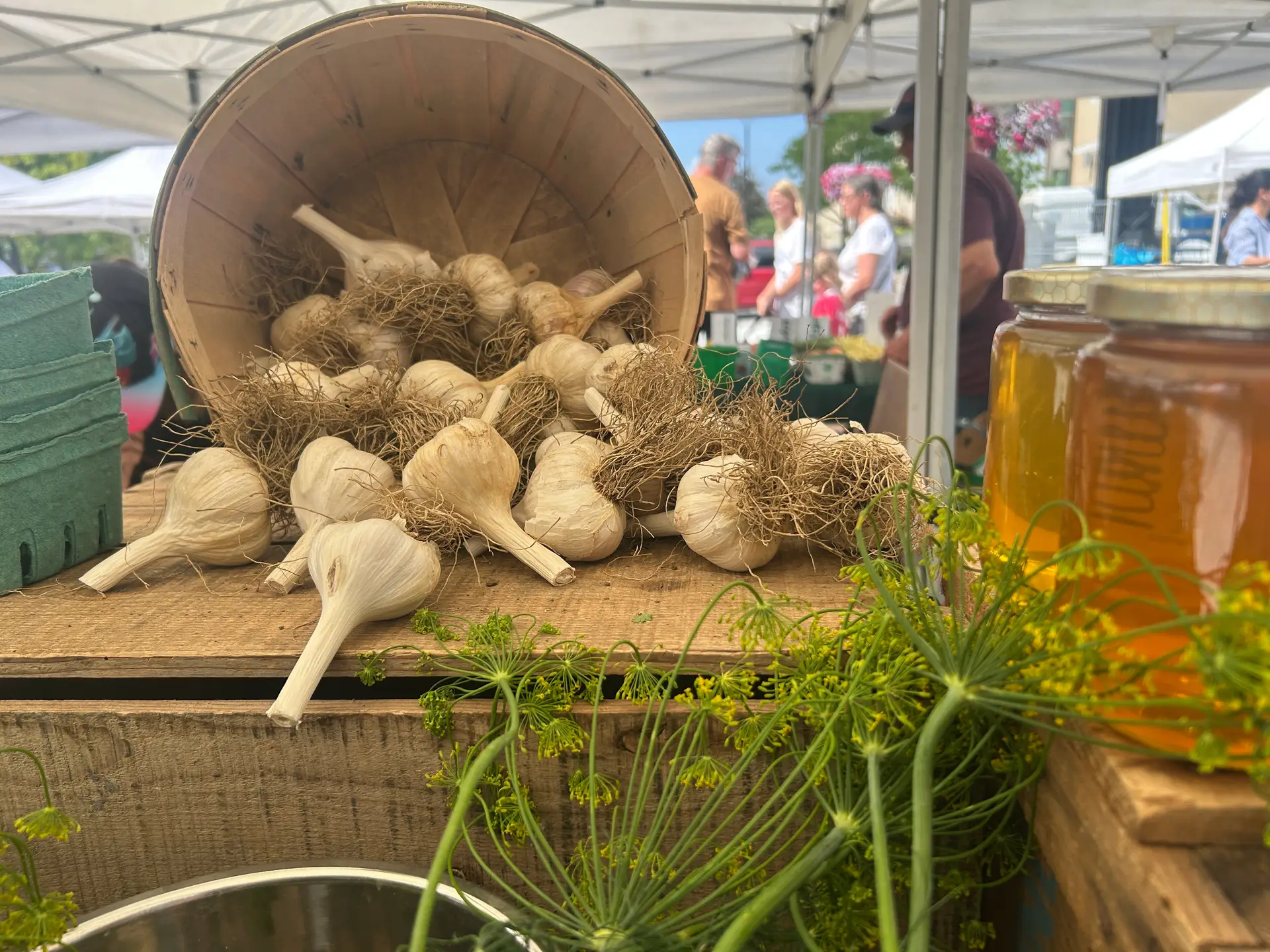
Green garlic or spring garlic from the Liliaceae family seems to be a well-kept secret amongst regular Farmers Market patrons. This doppelganger to the scallion (green onion) is usually only available until the end of May. Both the white bulb and green stalks are edible and have a mild nutty onion flavour that can be enjoyed cooked or raw. The health benefits of this immature garlic bulb are the same as mature garlic. It has a high amount of allicin, a powerful antioxidant and may boost the immune system when consumed in large quantities.  

When season-extending growing methods are utilized, farmers can produce an extensive array of early leafy greens. You can find examples in spring mix salad and spinach available at the Farmers Market! The deep green colour is so appealing, and it provides you with lutein that may help decrease the risk of age-related macular degeneration. On top of that, they are sources good vitamins A, C, K and iron as well as some dietary fibre! 

A spring Farmer’s market would not be complete without rhubarb! It is the stem (petioles) of the oversized leaf that is the edible portion; the leaf is poisonous due to the high content of oxalic acid. This slightly sweet but tart vegetable is more commonly considered a fruit and often referred to as a pie plant. After 1775, when sugar became more plentiful, rhubarb gained appreciation. Although it can be consumed raw, the most common method of preparation cut in chunks, and cooked with sugar.  Rhubarb can also be frozen for use later but will last up to 3 weeks when refrigerated. It pairs nicely with ginger, nutmeg and cinnamon and is often combined with strawberries. Rhubarb is low in calories, has Vitamin A, C, K and Calcium and dietary fibre. It has been shown to lower LDL cholesterol, and the presumed antioxidant effect may offer some benefits to the immune system.  

 As farmer markets continue to open up, keep an eye out for these nutritionally dense and fresh vegetables! 


About the author: Susan Smith is a volunteer at the MLFPC with long-standing expertise in nutrition. She graduated from UWO, Brescia University College in 1995 and has been a clinical dietitian at the London Health Science Center for almost 25 years! Susan has a keen interest in sustainable food systems that create a harmonious urban-rural relationship with a focus on community health and a minimal carbon footprint. 


What You Need to Know About Covent Garden’s Outdoor Farmers’ Market

Covent Garden’s outdoor Farmers’ Market will brighten up downtown London again, starting this Saturday, May 15. Here’s how the market will focus on customer safety during the ongoing COVID-19 pandemic. 

The market will only be operating on Saturdays from 9:00 AM to 1:00 PM.  In consideration of the COVID-19 situation, however, it won’t yet be the social gathering place we’re used to. Instead, the market will be focused on grocery operations for customers to purchase essential items and support the local economy. Here’s how the market will focus on customer safety

 Prior to entering, customers will be screened and asked to sanitize their hands while following rules that will be laid out on a signboard by the entrance. They will also have a hand-washing station set up for vendors. The market square will be roped off to limit the entrance and exit to Talbot Street, where they will have Security posted. On the ground, customers will find chalk markings leading them to a safe exit as they shop for essentials. These restrictions are to ensure that shopping is an ‘in and out’ process, and the flow of traffic is controlled. 

 The market encourages the use of cashless methods; however, they will be allowing cash depending on the vendors’ choice. They are also allowing vendors to operate their stands as a pick-up point or a hybrid situation for pre-orders and immediate sales. Most importantly, they are following all of the recommendations that have been provided by the Middlesex-London Health Unit and are monitoring the situation carefully.

A great aspect of this market is the accessibility to those who bike in the city. It offers a central location with secure bike parking. Even though the Covent Garden’s Outdoor Farmers’ Market is not currently a place of social gathering, you can make the most of an essential trip by getting some fresh air!

thumbnail_IMG_087AB70A0902-1

Farmers’ Markets Provide a Welcome Option for Fresh Local Food!

Farmers’ markets in London and Middlesex County are open for business! While we mostly stay at home and practice physical distancing, many of us still regard an outing to gather groceries an essential trip. Grocery stores are also doing their best to keep their spaces safe, but we know that crowds and lineups have occasionally developed. Luckily, more food outlet options are on the horizon! Farmers’ markets in the Middlesex-London community are open for business. When you go to a farmers’ market, not only will you have access to many of your grocery store necessities, but you will also be able to bring home the freshest restaurant-quality ingredients. 

A farmers’ market offers a different experience from a grocery store. Even at a careful distance, you get to recognize growers and build relationships with them while learning about the origins of your food. In many instances, you get to stay outside in the fresh air that we’re all craving, with enough space to feel secure. When you purchase at a farmers’ market, you support your local economy and help reduce carbon emissions from the hauling of food. Finally, by shopping close to home, you reduce the crowding of public spaces in the grocery stores and elsewhere.

To make sure that shoppers and vendors are as safe as possible, Farmers’ Market Ontario has released public safety protocols for farmer markets so that you feel confident in your shopping choices! There are two options that farmer markets can follow.

Option 1: Protocols for the multi-vendor, multi-stand market (for food sales only)

Market managers must first ensure their landlord approves of the reopening. They will then contact their local public health unit and present their health and safety plans for reopening. The FMO COVID-19 Fact/Info Sheet is then given to vendors and shoppers, while records of all active vendors/volunteers are recorded daily. When walking into the market, hand sanitization for vendors and shoppers are required and continuously restocked. Though it’s not required, The Western Fair Market even does active screening of every shopper when they arrive and turns away anyone who does not pass. Vendors must also wash their hands and sanitize their stations regularly. Each vendor must be adequately spaced so that circulation can be monitored. Unlike regular operations, shoppers will not be able to sample food or use reusable containers. All of these regulations will be put in place alongside the maintenance of social distancing (2 meters apart).

Option 2: Protocols for E-Commerce/E-Market protocols

This model is for markets that plan to operate an e-commerce model with a drive/walk-through pickup for pre-ordered and prepaid food. Similar to the previous model, market managers must also ensure their landlord approves of the reopening while contacting their local public health unit. The market must provide the local health unit with a plan displaying traffic circulation, and a delivery plan which includes physical distancing measures. This model also highlights the importance of hand sanitization. Before starting, vendors and volunteers must be screened for COVID-19, ensuring that they are healthy, and have not travelled outside of Canada recently or have come into contact with someone who has COVID-19. All surfaces where orders have been placed must be continuously cleaned. Each food product will be prepackaged in single-use containers with proper labelling. Finally, all refrigerated and frozen items must be stored at proper temperatures. For more information on these protocols visit: https://www.farmersmarketsontario.com/covid-19-modifying-market-operations/

As farmer markets have been identified as an essential business, the Middlesex-London Health Unit has also posted their recommendations. In terms of setting up, it’s recommended for markets to create a diagram of the layout. When creating this layout they should consider the flow of traffic making shopping an ‘in and out’ process. Social distancing of 2 metres is maintained by reducing the number of vendors and customers purchasing at once. Prior to attending the market, vendors must submit the Market Vendor Form to the Middlesex-London Health Unit. All vendors who show any symptoms of sickness (fever, cough, sore throat, etc.) will not be able to attend the market. It is encouraged that payment is done through cashless methods. Payment devices and high-touch surfaces will be disinfected multiple times a day. Similar to the regulations we see from the government of Ontario, sanitation resources must be provided for customers and vendors. The health unit also prohibits the use of customer-supplied containers and food sampling while limiting customers’ contact with food. Markets can also consider taking orders before opening and offering pick-up service. In addition, the health unit advises markets to consider prepackaging food and having only vendors handle products. For more information on these recommendations visit: https://www.healthunit.com/covid-19-resources-workplaces#Setting-Specific-Guidance

You may still need to visit a grocery store now and again, especially one in your own neighbourhood. But with the abundance of farmers’ markets in the Middlesex-London area, there’s plenty of room to shop and support our local economy!

thumbnail_OEVGrocer April 16 (1).jpg

Provincial reopening of Community Gardens

On the morning of April 25th, 2020, the Province of Ontario announced an amendment to the COVID-19 emergency order permitting the use of allotment and community gardens. 

Permit the use of allotment gardens and community gardens across the province. These gardens are an essential source of fresh food for some individuals and families, including those who face food insecurity. Local medical officers of health will provide advice, recommendation and instructions that the gardens must meet in order to operate, such as physical distancing, and cleaning and disinfecting commonly used equipment and surfaces. 

We are very pleased that the Province has recognized the importance of the community gardens for individual and community food security. Food insecurity is an ever-present challenge for Middlesex-London, which is increasing this year with the disruptions from the pandemic. We are looking forward to announcements from the City of London and other municipalities in the area regarding details of when they will be allowing public access to their garden plots and what guidelines they will be operating under. We will be sharing those details with you as they are made available. Congratulations and thank you to everyone who has been involved in advocating for this. Your support and letters to your MPPs have been heard and effective. 

The community gardens are only part of the solution for food insecurity. More is still needed. We at the Middlesex-London Food Policy Council are continuing to explore other ways that we as a community can increase food security now and bolstering our community’s resilience and food sovereignty for the future. We are pleased to hear from you concerns and ideas for continuing this work. Feel free to comment on this post or contact us at info@mlfpc.ca.