
As you may know, the green bin program is live in London! This has been a long-awaited strategy to help reduce landfill waste and greenhouse gasses. While this is an important program to help support the environment, another and, arguably, more effective step in the waste hierarchy is to reduce food waste from the beginning.

The green bin and recycling programs offer great ways to sort our waste. However, instead of filling our bins with the food scraps and leftovers we have, we may want to shift our focus to reducing the amount of food waste we have in the first place. In this way, we aren’t necessarily focused on filling our bins, but just now have an appropriate way to dispose of the food waste we do end up with. While I am no expert in this, I thought I would share ways I try to play my part to reduce food waste in our home in case it will be helpful for you!
 Meal planning. While it may seem obvious for a dietitian to suggest meal planning as a solution, it works! Meal planning can help us figure out what foods and amounts we actually need, so less ends up in the bin. Meal planning does not need to be complicated. It’s just about adding in an extra step before grocery shopping that helps us better understand what we need, rather than purchasing aimlessly. Some meal planning tips include:
-
- Taking an inventory of foods you already have in your fridge, freezer, and pantry
- Planning your meals based on these foods and using any foods that will soon expire first
- Preparing a grocery list based on your decided meals (crossing off any items you already have)
- Following your list as much as possible
- Limiting impulse purchases
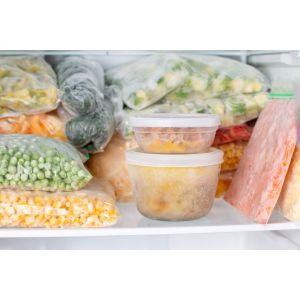 Freeze leftovers. Sometimes, no matter how much we plan, we end up with leftovers or extra food that we either can’t eat in time before it will spoil or perhaps the family is done with that meal for the time being. In these cases, freezing leftovers can be a great way to reduce food waste and have an easy meal ready to cook later that week or month. As I am writing this, I am thinking about the lasagna I have prepared in the freezer on the menu for dinner tonight, and I am excited about not having meal prep today!
 Use food scraps. This is something I am working to become better at, but making broth has been a game changer when it comes to reducing food waste. You’re free to use whatever food scraps you have like broccoli and mushroom stems, cauliflower leaves, garlic, wilted leaves or celery, and even whole vegetables that you are not going to be able to use.
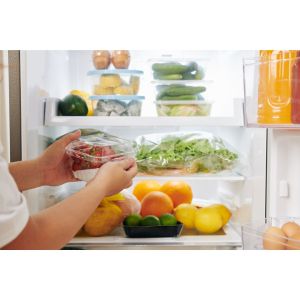 Store food safely and appropriately. This can be an important way to preserve food for as long as possible. Check out this resource from Foodland Ontario to help you safely store your perishable foods.
 Have you ever rescued your food? This isn’t one of the common R’s of waste but an interesting way to revive food that we thought would be meant for waste. One of my favourites is putting softening grapes, cucumbers, and berries in water in the fridge overnight and waking up to firmer produce in the morning! Check out some other ways to rescue common foods here.
While it can be frustrating from a consumer perspective to make changes in our homes while larger companies and corporations seem to be producing much larger amounts of waste, I’ve resolved to the idea that all we can do is our part. I believe the combination of all our parts can truly make a difference!

What are your favourite ways to reduce food waste? Let me know in the comments!
Written by Prab Kaur, MSc. RD