
Written by Ellen Lakusiak. Edited by Ginette Blake, Kathy MacKay, and Matthew Wang
The desire to buy Canadian products has never been stronger. When it comes to food, however, it can be a bit more challenging. Much of our food, especially produce, comes from other countries, particularly in the winter and spring. On top of that, food labeling can be confusing.
Product of Canada vs. Made in Canada
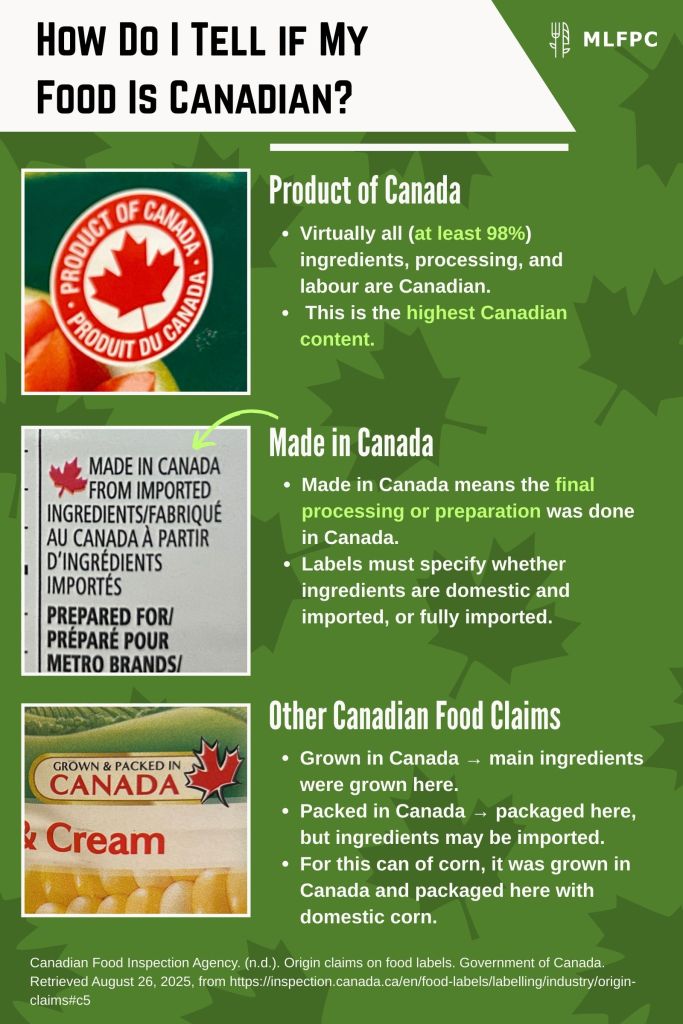
The Government of Canada provides guidance on origin claims on food labels. The use of “Product of Canada” and “Made in Canada” statements is voluntary, but once a company chooses to use either, the product must meet specific criteria (Canadian Food Inspection Agency [CFIA], n.d.-a).
A “Product of Canada“ label means that virtually all major ingredients, processing and labour used to make the food product are Canadian. Less than 2% of the ingredients (e.g. spices, coffee) are from elsewhere (CFIA, n.d.-a).
A “Made in Canada” claim can be used on a food product when the last substantial transformation of the product occurred in Canada, even if some ingredients are from other countries. There always has to be a qualifying statement that provides more details (CFIA, n.d.-b).
To qualify for either label, the food must undergo its “last substantial transformation” in Canada. For example, turning dough, sauce and cheese into pizza or mixing grains and ingredients to create breakfast cereal.
If you see a Canadian flag on a product without a qualifying statement, it still must meet the “Made in Canada” standards (CFIA, n.d.-b).
Other Canadian Food Claims Explained
Beyond “Product of Canada” and “Made in Canada,” many foods highlight Canadian involvement in other ways. These claims are allowed as long as they are truthful and not misleading.
Some common examples include:
- Roasted and blended in Canada – imported coffee beans roasted or blended here.
- Distilled in Canada – water distilled in Canada.
- Canned in Canada – vegetables or beans canned here.
- Refined in Canada – imported sugar refined in Canada.
- Processed or prepared in Canada – food fully processed or prepared locally.
- Packaged in Canada – bulk or imported food packaged into retail containers here.
You’ll also see claims about specific Canadian ingredients, like “Canadian cheddar cheese” or “Contains Canadian blueberries.” These mean that all of that ingredients, include including any derivatives like cheese sauce or blueberry juice concentrate, is Canadian.
These statements help you identify Canadian value added, even if the entire product isn’t fully made in Canada. Always check the label for qualifying details to know exactly how Canadian the product is.
What About Using an App?
Several free apps have been developed to help consumers identify truly Canadian products. These tools simplify the search by evaluating how Canadian a product is based on sourcing, processing and labeling. Try one to see which suits your shopping habits best: .
- BuyBeaver – rates products on Canadian content (ingredients, manufacturing, ownership). (BuyBeaver, n.d.)
- Maple Scan – barcode/photo scanner with Canadian alternatives. (Maple Scan, n.d.)
- CanMade – barcode/photo scanner, iPhone only, highlights Canadian-owned brands and local sourcing. (Farooq, 2025)
- Is this Canadian – photo scan or search for Canadian-made. (Is this Canadian, 2025)
Can Buying Canadian Fit in Your Food Budget?
Food prices have risen significantly in recent years, but buying Canadian does not always mean paying more. Consider the following tips:
- Buy frozen foods instead of fresh, especially fruits and vegetables. Look for “Product of Canada” on the packaging. If avoiding U.S. produce, seek items from Mexico, Chile, Spain or Egypt). Many Canadian-grown foods, such as blueberries, strawberries, squash, sweet potatoes, peas and beans, are frozen at peak freshness and are often more affordable than buying fresh options.
- Canned foods like lentils, dried beans, corn and some fruits are Canadian grown and typically cost less than fresh alternatives.
- Stock up when items are on sale. Products such as breakfast cereals, crackers, canned goods and frozen items often have long shelf lives. Purchasing in bulk during promotions can save money.
- Shop local for greenhouse-grown produce. Tomatoes and leafy greens are available year-round from Canadian greenhouses and are often competitively priced compared to imported produce.
Final Thoughts
It has become easier than ever to identify food that is truly made in Canada. With this new access to clear labeling and helpful digital tools, we are now better equipped to support Canadian farmers, processors and food producers. Let’s take advantage of these resources and make informed choices that benefit both our communities and the national economy.
Want to Learn more:
https://inspection.canada.ca/en/food-labels/labelling/consumers/canadian-food
References
BuyBeaver. (n.d.). BuyBeaver: Find Canadian-made products easily. https://www.buybeaver.ca/
Canadian Food Inspection Agency. (n.d.-a). Origin claims. Government of Canada. https://inspection.canada.ca/en/food-labels/labelling/industry/origin-claims
Canadian Food Inspection Agency. (n.d.-b). Made in Canada and Product of Canada claims. Government of Canada. https://inspection.canada.ca/en/food-labels/labelling/industry/origin-claims#c5
Farooq, H. (2025, February 15). Brandonite develops app to help shoppers buy Canadian. Brandon Sun. https://www.brandonsun.com/local/2025/02/15/brandonite-develops-app-to-help-shoppers-buy-canadian
Is this Canadian? (2025). Is this Canadian: Scan & check. App Store. https://apps.apple.com/ca/app/is-this-canadian-scan-check/id6741718092
Maple Scan. (n.d.). Maple Scan: Buy Canadian. https://maplescan.ca/
Toneguzzi, M. (2023, November 23). Made in Canada? Here’s what to know about misleading product labels. CBC News.https://www.cbc.ca/news/canada/made-in-canada-product-of-canada-1.7451556