The National School Food Program
April 1st, 2024 was not marked by the usual April Fool’s Day antics, but by something more significant that will impact the lives of millions of Canadian children and their families: Prime Minister Justin Trudeau announced the launch of a National School Food Program (NSFP). This program is set to provide nutritious meals to students across the country. This means better academic and health outcomes for Canadian children. The idea of a national school food program in Canada is not new. Canada was the only G7 country (an informal grouping of seven of the world’s leading economies) without a NSFP. Health professionals, teachers, organizations, and parents have for a long time been advocating for a national school food program, recognizing the important role that nutrition plays in a child’s development and learning. The hope is with a NSFP, that every child has access to at least one nutritious meal a day while at school.
The Prime Minister’s announcement outlined a comprehensive plan that will be rolled out in stages. The program is set to receive one billion dollars over five years. It aims to provide meals to 400,000 children annually, in addition to those served by the local food programs. This staged approach will allow for different communities across Canada to make it work best for them (Government of Canada, 2024).
On June 20th, the Prime Minister announced the new NSFP Policy. The new policy outlines the NSFP vision: “That all children and youth in Canada have access to nutritious food at school, in an inclusive, non-stigmatizing environment that fosters healthy practices, while strengthening connections with local food systems, the environment and culture.“
The NSFP hopes to see children getting meals before the end of the 2024-2025 school year. Additionally, the school food program will count on existing organizations that already provide meals and snacks to students.
There are six guiding principles for the policy: Accessible, Health Promoting, Inclusive, Flexible, Sustainable, and Accountable.
One important aspect of the NFSP is universality. This means all children will have access to the program and receive a free meal or snack. The food served will be consistent with the healthy eating recommendations in Canada’s Food Guide. Children will have opportunities to learn and develop their nutritional knowledge and food skills. Also, children will have access to culturally appropriate school food programs which aim to engage students and communities.
The NSFP will try to source local foods when possible. Programs are designed to be environmentally sustainable and well-resourced. Also, the NSFP will aim to create partnerships with the local food producers and farmers. The partnerships will not only support the local economy, but the program will take a more sustainable approach in reducing the carbon footprint. This will align with the broader efforts to combat climate change and create a more sustainable future. The programs will be evaluated and monitored consistently to ensure they are achieving the policy objectives (Canada, 2024).
What does this mean for Canadian children and their families?
For children it means having access to nutritious food while at school.
For parents it means peace of mind knowing their children will not go hungry while at school. And for the many families struggling with grocery prices, this program is expected to save the average family with two children as much as $800 per year in grocery cost (Government of Canada, 2024).
Next steps…
The Policy underlines the importance of ongoing collaboration with partners across Canada. This will include coordination with provinces, territories, and First Nations, Inuit, and Métis partners to advance the vision. The Policy concludes with a commitment from the Government of Canada to work with various levels of government and partners “to improve access to information on school food programing, report on progress, and share best practices.”
I am eager to see this plan in action, and I am committed to supporting local partners and their initiatives. The NSFP will address critical needs of children, as the benefits of this program represent the government’s commitment to nurturing the next generation and investing in their future. Although there will be changes and challenges moving forward, coming together as a nation to advocate for the health and future of our children is possible.
Written by Octavia Vanca, Dietetic Practicum Student
For more info, visit:
https://www.healthyschoolfood.ca/post/release-of-the-national-school-food-policy
https://www.cbc.ca/news/politics/liberals-national-food-program-1.7241745
https://globalnews.ca/video/10582513/canada-wide-school-food-program-in-the-works/
References:
Government of Canada. (n.d.). National school food policy: What we heard report. Retrieved from https://www.canada.ca/en/employment-social-development/programs/school-food/reports/national-policy.html
Government of Canada. (2024, April 1). National school food program set up for kids’ success. Retrieved from https://www.pm.gc.ca/en/news/news-releases/2024/04/01/national-school-food-program-set-kids-success
Coalition for Healthy School Food. (2024, June 20). Release of the national school food policy. Retrieved from https://www.healthyschoolfood.ca/post/release-of-the-national-school-food-policy
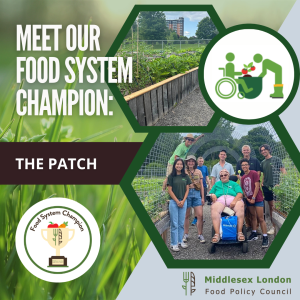 The idea for a community-driven urban farm was born during the pandemic when Joe Gansevles recognized the need for accessible food in the London area. From bylaws, to being on a floodplain, to a lack of funding, challenges seemed to pop up at every corner. However, with the help of community members they were able to overcome these obstacles and form the PATCH!
 provide employment training, and cultivate a safe space for volunteers and community members to garden and meet new people. Their stunning Cavendish Community Food Hub location is equipped with wheelchair-accessible gardens, follows eco-conscious practices, and has generated thousands of pounds of fresh produce this year!
 accessible pots, raised garden beds, and roomy pathways to ensure participation from individuals of all abilities. Their Cavendish location exemplifies resourceful practices by repurposing donated wooden pallets as materials for garden beds, and redirecting waste as soil-enriching compost that is donated by The Wormery at the Western Fair District (thanks, Dan!). Committed to sustainability, they primarily deliver their produce to organizations by bicycle, clocking over 750k miles. Among their partnerships, they generously contribute their harvest to organizations such as the London Food Bank, Ark Aid Mission, and Indwell . It is truly a community effort!
 designed for all to enjoy, regardless of sensory limitations. Additionally, they have plans for a streamlined irrigation system.
  operative housing complexes could have, that a university could have, that large-scale employers that have land that they could re-purpose and utilise for their workforce. Our long term plan would be that we can live in a city where there’s easy economical access to food for people, and this is an open-patent design. People can come and they can liberate what we’ve done and they can do it in their neighbourhoods, schools, and workforce.
  Sixteen-year-old Zhawanoogbiik Danielle Riley embodies the spirit of compassion and community care. She has demonstrated great initiative as a Food System Champion by helping connect others with the resources they need to care for their animals.
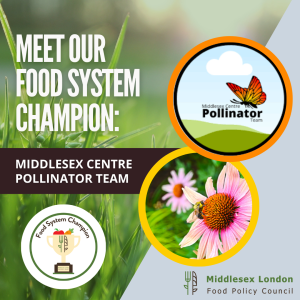 The Middlesex Centre Pollinator Team has truly shined in supporting our local food system.
 On The Move Organics, founded in 2008 by Jeff Pastorius, is on a mission to rebuild Ontario’s local food system by connecting with local farmers. Starting with bike deliveries in the Old East Village, the company expanded to offer groceries and delivery vehicles as demand grew.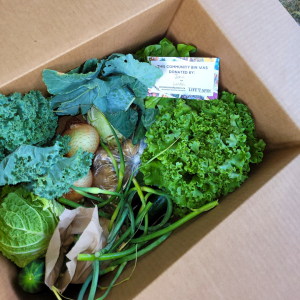
 non-carbon delivery options like bike deliveries and electric alternatives, and improve efficiency in their warehouse to reduce food waste and environmental impact. With a dedicated focus on locality and community outreach, On The Move Organics aims to make positive strides in the food system for years to come. Check out On The Move Organics’ website for more information:
  The London Food Co-op, a member-owned grocery store, has been supplying affordable, ethically sourced, and Fair Trade products to London families since 1970. For over half a century, it has prioritized local, organic foods, and originated as a buying club for those keen to know where their food comes from. Today, it remains committed to these principles, supporting local farms and small businesses in Ontario, offering everything from organic meat to maple syrup.
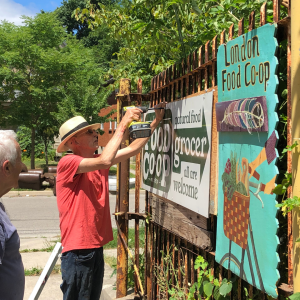 The Co-op is planning to host a variety of community events in the future such as urban gardening workshops and hopes to introduce a teaching kitchen for cooking demonstrations. As a community-based, not-for-profit grocery store, the London Food Co-op fosters consumer-producer relationships, prioritizing people’s needs over corporate profits. This not only allows shoppers to feel good about their groceries, but also promotes health and sustainability. Visit them at 621 Princess Avenue and experience first-hand how the London Food Co-op is not just a store, but a movement, nurturing a healthier, more sustainable, and more connected community one grocery trip at a time.